


 written by
In a context where legislation changes constantly, competition is increasing, and employees expect simple and fast processes, HR digitalization is no longer optional—it’s a requirement for operating efficiently.
Today, HR digitalization is not just a software tool or a better-organized Excel file. It represents a deep transformation of how people, data, and processes work together.
Modern HR is more than an administrative department: it becomes a strategic partner, a driver of efficiency, and the guardian of a coherent employee experience.
What HR Digitalization Is: A Clear and Simple Definition
HR digitalization is the process of transforming human resources activities and workflows from manual, fragmented, paper-dependent operations into an integrated, automated, data-driven system.
It means shifting from reactive processes to proactive, traceable, efficient workflows that are accessible in real time—for HR, employees, and managers alike.
What HR Digitalization Is NOT
A few myths still prevent companies from moving forward:
-
Digitalization means buying an HR software.
Without a strategy, a new software simply moves the problems into another interface. -
Putting documents in PDF format is enough.
A PDF is not real digitalization—it’s just a scanned version of paperwork. -
Processes can stay the same, just faster.
If you keep the same complicated steps, workflows remain slow. True digitalization requires rethinking processes, removing unnecessary steps, and logically automating time-consuming actions.
The Stages of HR Digitalization
Real digitalization is not about turning papers into PDFs. It’s about making processes shorter, clearer, and more efficient.
It automates steps that do not require human intervention, offers real-time data, and connects employees with HR through SelfService while ensuring legal compliance through proper traceability and archiving.
These changes become visible immediately:
-
Digital time tracking with automatic approvals
No more manual entries; managers approve quickly in the app. -
Payslips available directly in the platform
No emails, no printing, no confidentiality risks. -
Leave requests with a fully digital workflow
Created, approved, and archived automatically—no HR visits needed. -
Automatic generation of employment certificates
Employees can download standard certificates themselves. -
Digital onboarding
Documents, tasks, information, and trainings—all in one place. -
Structured electronic archive
All employee documents are safe, organized, and easy to access. -
Digital org chart
Gives full visibility of the internal hierarchy, with roles and reporting lines updated automatically as changes occur. -
Direct integration with Payroll
Personal data, time tracking, and contractual changes flow automatically into payroll, eliminating human errors and repetitive work.
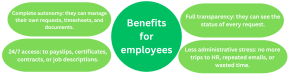
The Benefits of HR Digitalization for Everyone
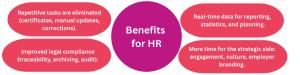
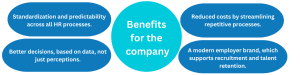
HR Digitalization & Legislation: What You Need to Know
HR digitalization aligns perfectly with current legislation—and even simplifies it. According to Government Decision no. 1.080/2022 and regulations on electronic archiving, many HR documents can be stored digitally if the system ensures:
-
authentication
-
traceability
-
document integrity
-
controlled access
-
accurate time records
Electronic time tracking is fully valid if the system ensures:
-
accuracy of hours
-
prevention of unauthorized changes
-
access for labor inspectors
Cultural Transformation: The Unseen Side of Digitalization
Adopting a digital system works best when people feel their voice matters. Cultural transformation must be supported through:
-
openness to change
-
an efficiency-oriented mindset
-
ongoing employee feedback on their experience with new processes
-
analysis of platform usage to identify real bottlenecks
-
abandoning the “we’ve always done it this way” approach
-
shared responsibility—HR, managers, employees
How to support cultural transformation:
Through constant and clear communication, benefit-focused training, engaging managers as ambassadors of change, and ongoing feedback that enables real improvements.
Digitalization is not an IT project—it is a people project.
Where to Start HR Digitalization (4-Step Plan)
-
Identify repetitive, time-consuming processes
Leave requests, time tracking, certificates, personnel files, onboarding. -
Analyze the current workflows
Where do things get stuck? What takes too long? What depends unnecessarily on HR? -
Choose a scalable, integrable solution
It must grow with the organization and integrate with existing systems. -
Measure results in the first 90 days
-
hours saved
-
automatically processed requests
-
approval times
-
internal feedback
-
Every step should free your people from administrative tasks so they can focus on what matters: themselves.
Studies Confirming the Need for HR Digitalization
According to recent studies, HR digitalization is no longer a technical project, but a strategic transformation:
-
Up to 60% of administrative processes can be automated.
-
Employees expect fast, transparent interactions.
-
Organizations that adopt digital solutions increase HR efficiency by 40–50%.
-
With 44% of job skills changing in the coming years, digital readiness becomes essential.
McKinsey: ~50% of administrative activities can be automated with current technology.
Gartner HR Research: 64% of employees judge their work experience by how easy it is to “get things done.”
Deloitte: Only 11% of organizations consider their HR processes “fully modernized.”
World Economic Forum: By 2030, over 40% of employees will require digital reskilling.
Digital HR — A Popular Term, Rarely Understood
HR digitalization is not a luxury—it’s a necessity. And it all begins with one simple question:
“Which process do I never want to repeat manually again?”
That answer is your first step toward modern, efficient, people-centric HR.
If you want to see how a fast, uncomplicated HR transformation looks, request a demo of the platform and discover what a digital space built for Romanian companies truly means.
We are Smartree, a trusted partner in payroll outsourcing and personnel administration, with 25 years of experience in the Romanian HR market. We deliver innovative, strategic, and automated solutions for your HR challenges. Beyond the expertise of our payroll, HR, and labor legislation specialists, and beyond the continuously evolving MyStaff platform, one promise remains unchanged: to support you with responsibility and professionalism. Contact us for a discussion!